
Epistra Inc. (Location: Minato-ku, Tokyo; CEO: Yosuke Ozawa; hereinafter “Epistra”) has reached an agreement with Shimadzu Corporation (Location: Kyoto City; President & CEO: Teruhisa Ueda; hereinafter “Shimadzu”) to jointly develop a culture condition optimization solution for cell culture. Both companies aim for commercialization in 2024.
Overview of the Joint Development
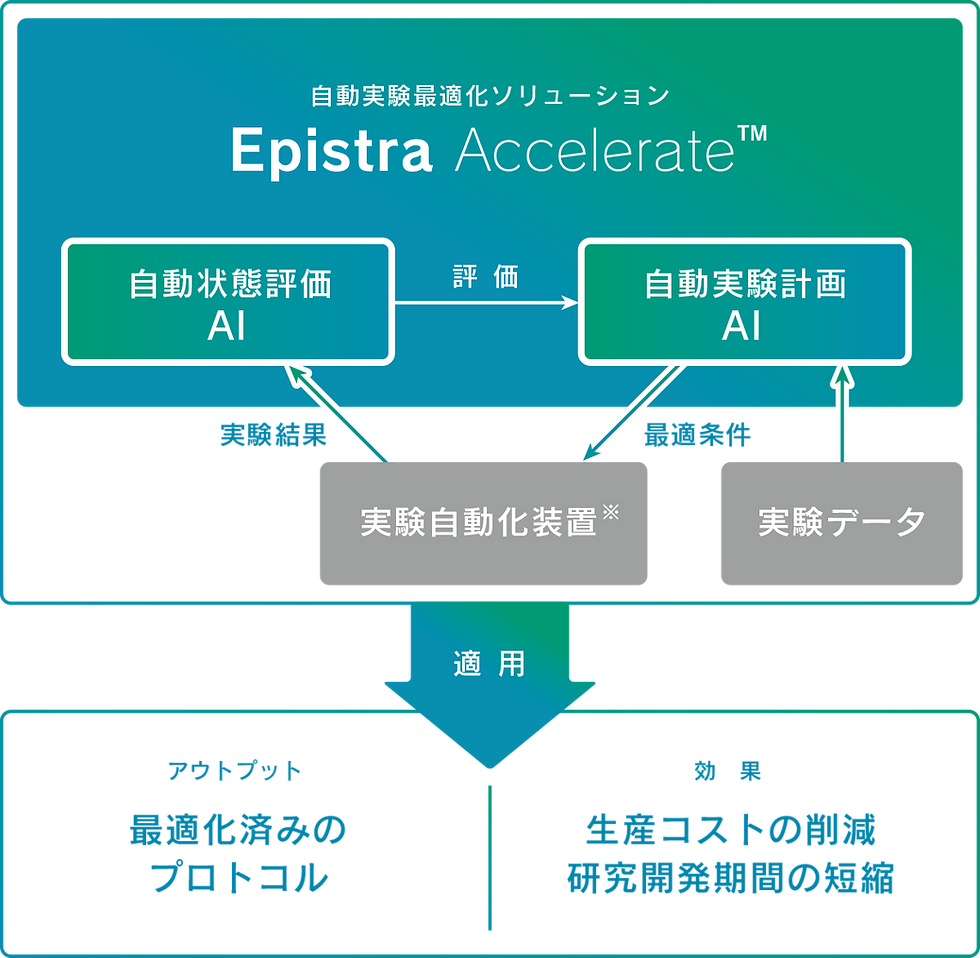
By utilizing culture supernatant component data (125 components) measured with Shimadzu’s “LC/MS/MS Method Package for Cell Culture Profiling Ver.2,” Epistra’s experimental design support AI (Epistra Accelerate) estimates culture states and generates experimental plans based on those estimates, aiming to streamline condition screening in cell culture.
Cell culture is a foundational technology widely applied across industries, including the production of biopharmaceuticals such as antibodies, therapeutic cells for regenerative medicine, and industrial fermentation of useful substances. While biopharmaceuticals have demonstrated remarkable therapeutic efficacy in recent years—such as immune checkpoint inhibitor anticancer drugs and COVID-19 therapeutics—their manufacturing process costs are substantially higher than those of small-molecule drugs, driving up treatment costs per patient and putting significant pressure on healthcare finances. Improving cell culture efficiency increases productivity and lowers manufacturing costs, enabling the supply of more affordable biopharmaceuticals to the public.
In the process of producing specific substances inside cells, particular gene networks (signaling and metabolic pathways) are activated within the cell, and their byproducts and morphological changes appear as clues before the final outcome is reached. Extracting these features from culture supernatant component patterns can shorten the time required for each round of condition screening, offering the potential to dramatically streamline condition optimization for productivity improvement.
Proof-of-Concept Experiments Initiated at the MAB Association Kobe GMP Center
To jointly develop a media optimization solution combining both companies’ technologies, Epistra—as a member of the Manufacturing Technology Association of Biologics (Chairman: Koichi Nakao, President & CEO of Takara Bio Inc.; commonly known as the MAB Association)—received cell supply (Note 1) and began proof-of-concept experiments with the cooperation and technical guidance of MAB Association members. We will advance the development of AI that analyzes culture supernatants via LC/MS/MS to estimate final antibody yields.
Note 1: This research was supported by the Japan Agency for Medical Research and Development (AMED) under Grant Number JP20ae0101066.
LC/MS/MS Method Package for Cell Culture Profiling Ver.2
This is an LC/MS/MS method capable of simultaneously analyzing a total of 125 components—comprising media components and secreted cellular metabolites—within 20 minutes. Whereas analyses previously had to be performed separately by compound group such as amino acids and vitamins, this method package enables simultaneous analysis in under 20 minutes.
Because the analytical method is optimized for culture media containing both high-concentration components (such as glucose and amino acids) and trace components (such as vitamins), simultaneous analysis of a broad range of components is possible. Furthermore, it is a Ready-to-Use Method that allows users to begin analysis immediately without cumbersome tasks such as developing separation conditions or optimizing MS parameters for individual compounds.
Website: https://www.an.shimadzu.co.jp/lcms/tq-option/mp_profiling_cell-culture.htm
Automated Experiment Optimization System: Epistra Accelerate
In life science research and development, numerous challenges arise from manual experimentation and repeated trial and error. Our AI-driven automated experiment optimization system, Epistra Accelerate, enables researchers to discover optimal target conditions in fewer trials than before.
Our proprietary automated experimental design AI is enhanced specifically to solve life science problems by implementing our original algorithm based on Bayesian optimization technology. Applying standard Bayesian optimization to life science problems faces three major challenges (high dimensionality, high noise, and high cost), which our proprietary algorithm solves.
In joint research with RIKEN, Epistra Accelerate succeeded in automatically searching for a protocol that achieves differentiation efficiency exceeding that of skilled experts. Adoption by major corporations in biomaterials, food, and pharmaceuticals is also progressing.
Website: Epistra Accelerate
Company Profile
- Company Name: Epistra Inc.
- Japanese Name: エピストラ株式会社
- Representatives: Yosuke Ozawa, Takeshi Sakurada
- Established: March 2018
- Location: 2-2-15 Hamamatsucho, Minato-ku, Tokyo
- Web: https://epistra.jp
Related Articles
- Speaking Engagement: CEO Yosuke Ozawa Speaks at the 8th Salon de RINK "Transport and Manufacturing" Special Expanded EditionOn November 20, 2026, Epistra CEO Yosuke Ozawa spoke at the 8th Salon de RINK "Transport and Manufacturing" Special Expanded Edition, hosted by the Kanagawa Regenerative and Cellular Medicine Industrialization Network (RINK).
- Speaking Engagement: CEO Yosuke Ozawa Speaks at the 8th Bio Investment Guild (BIG) Hosted by Miyata Institute of TechnologiesOn November 13, 2026, Epistra CEO Yosuke Ozawa spoke at the 8th Bio Investment Guild (BIG), a members-only program hosted by Miyata Institute of Technologies.
- Epistra Accelerate Receives the FY2026 Tokyo Venture Technology Award Encouragement Award; Epistra Exhibits at Sangyo Koryuten 2026On November 11, 2026, Epistra's experimental condition optimization AI, Epistra Accelerate, received the FY2026 Tokyo Venture Technology Award Encouragement Award. Epistra also exhibited at Sangyo Koryuten 2026.