

We have published a development case study on our website highlighting how Astellas Pharma tackled the challenge of reproducibility in cell culture through the integration of AI and robotics. The article is presented as an interview with Mr. Atsushi Inoue (Astellas Pharma), who led this initiative.
For Those Working on Cell Therapy Research and Development: Do You Face These Challenges?
- High variability in long-term cell culture, resulting in low experimental reproducibility
- Unable to discover culture conditions that achieve targets through experience-based or literature-based condition screening
- Want to efficiently advance cell manufacturing process development, but lack concrete strategies
These challenges have long been barriers to the practical realization of cell therapies.
Especially in long-term cultures requiring differentiation induction, condition screening demands enormous time and cost, and cell culture-specific issues—such as “unable to test many conditions” and “not getting results as good as hoped”—have long troubled researchers on the front lines.
The Key to the Solution Was AI × Robotics
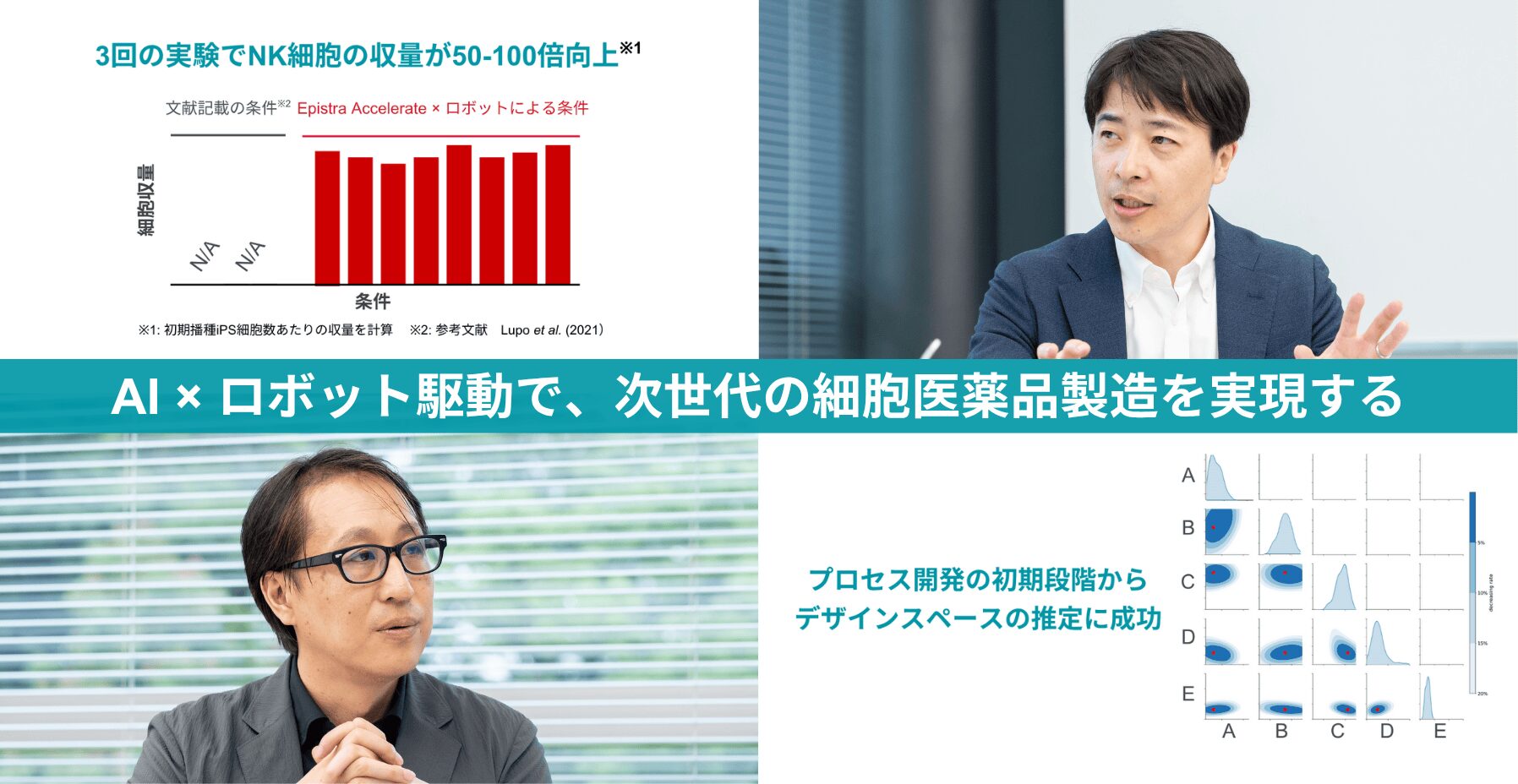
In the three-party collaborative case study “Optimization of the NK Cell Differentiation Process” by Astellas Pharma × Robotic Biology Institute (RBI) × Epistra, we resolved the aforementioned challenges and presented a new approach toward realizing next-generation cell therapy manufacturing.
[Result 1] “Consistent, Low-Variability Culture”
Experimental automation using robotics achieved highly reproducible culture (CV of 5.9%)
[Result 2] “Dramatic Yield Improvement”
Building on high-precision data generated by robotics, conditions were optimized using Epistra’s experimental condition optimization AI, Epistra Accelerate.
In just 3 months, numerous conditions achieving 50 to 100 times the yield reported in literature were discovered.
[Result 3] “Design Space Estimation Function”
Modeling of the condition space with Epistra Accelerate succeeded in estimating the effective operating range (design space).
This enabled QbD (Quality by Design)-conscious evaluation from the early stages of process development.
In the interview, we spoke with Mr. Atsushi Inoue of Astellas Pharma Inc., who led the project, about the background and outcomes of this initiative.
If you are interested in process development leveraging AI and robotics, we encourage you to read the full interview.
Related Articles
- Speaking Engagement: CEO Yosuke Ozawa Speaks at the 8th Salon de RINK "Transport and Manufacturing" Special Expanded EditionOn November 20, 2026, Epistra CEO Yosuke Ozawa spoke at the 8th Salon de RINK "Transport and Manufacturing" Special Expanded Edition, hosted by the Kanagawa Regenerative and Cellular Medicine Industrialization Network (RINK).
- Speaking Engagement: CEO Yosuke Ozawa Speaks at the 8th Bio Investment Guild (BIG) Hosted by Miyata Institute of TechnologiesOn November 13, 2026, Epistra CEO Yosuke Ozawa spoke at the 8th Bio Investment Guild (BIG), a members-only program hosted by Miyata Institute of Technologies.
- Epistra Accelerate Receives the FY2026 Tokyo Venture Technology Award Encouragement Award; Epistra Exhibits at Sangyo Koryuten 2026On November 11, 2026, Epistra's experimental condition optimization AI, Epistra Accelerate, received the FY2026 Tokyo Venture Technology Award Encouragement Award. Epistra also exhibited at Sangyo Koryuten 2026.